
What are public authorities looking for when adopting social innovations that can transform public policy?
Click here to read the article in Spanish
A social initiative can work, improve people’s lives and offer solutions to problems that once seemed difficult to tackle. But how can we ensure that an innovation that has proven its value reaches more people and becomes part of public policy? This is one of the major challenges facing social innovation: moving from individual initiatives to changes that can transform entire systems.
Scaling a social innovation does not simply mean replicating a successful project in other places or expanding it to reach more people. It means ensuring that a solution can grow, adapt to different contexts and, above all, become embedded in public structures and policies to achieve lasting impact. To make this happen, demonstrating that an initiative works is not enough: we also need to understand what public authorities need, what value the innovation can offer them and what conditions are required for its adoption.
So, what do public authorities expect from social innovation?
You can explore this question and many others on 13 November at the 14th European Forum on Experiences and Trends in Innovation for Inclusion, under the theme "Moving towards more innovative, more inclusive, and more connected systems". Organised by the European Network for Innovation for Inclusion and led by Action Against Hunger, the event will bring together professionals and organisations from across Europe to share knowledge and experience on how to drive systemic change through social innovation.
REGISTER NOW AND Secure YOUR SPOT
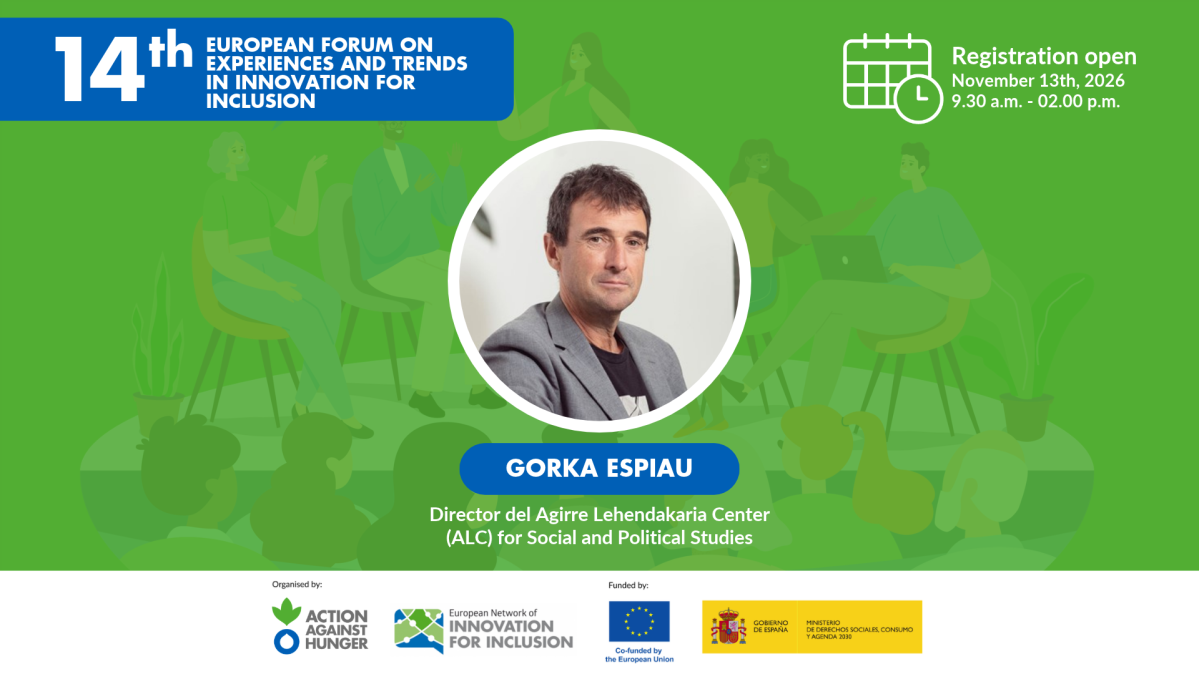
“Challenges of scaling to influence systemic change” will be one of the forum’s sessions. Featuring Gorka Espiau, Director of the Agirre Lehendakaria Center (ALC) for Social and Political Studies, it will provide an opportunity to explore public authorities’ expectations, the key factors behind successful scaling and the opportunities for collaboration between public institutions and social organisations.
First and foremost, public authorities expect solutions that address real needs and are backed by evidence of results. They also look for proposals that can be adapted to their structures, are sustainable over time and fit within existing policies and services. Collaboration between social organisations and public institutions is essential: social organisations contribute knowledge, experience and innovation, while public institutions can provide the resources, connections and framework needed to extend their reach. The challenge, but also the opportunity, lies in building solutions together, rather than simply transferring a project from one context to another.
HOW CAN WE MEASURE THE VALUE AND EFFICIENCY OF AN INNOVATION?
However, this process is not always straightforward. Social organisations may face funding barriers, a lack of resources, difficulties in demonstrating results, or challenges arising from the timelines and procedures of public administrations. Moreover, an innovation that works in one area will not necessarily work in exactly the same way in another. That is why scaling requires planning, the ability to adapt, partnerships and a shared understanding of what needs to change.
How can these barriers be overcome, and what does it take for social innovation to influence public policy? Join us at the 14th European Forum to explore these questions.
Social innovation does not reach its full potential simply by proving that it works. It does so when it transforms the way we address social challenges. The real challenge is to ensure that effective solutions stop being exceptions and become part of wider change.