
Sign up for the online course: “The process of Social Innovation”
Are you interested in discovering new tools, approaches, and experiences to drive social innovation? We invite you to take part in our online course 'The process of Social Innovation', which includes:
- Four participatory online training sessions, featuring teamwork activities and practical application to real-life cases.
- E-learning support, with access to activities and complementary materials that will help you consolidate and put into practice what you have learned.
- Proprietary methodologies for managing social innovation, such as the IRIX model and the HELIX design and evaluation manual.
- A micro-credential, awarded upon completion of the training, recognising the knowledge and skills you have acquired.
The course will be delivered in English by Julen Etxebeste, Social Innovation specialist.
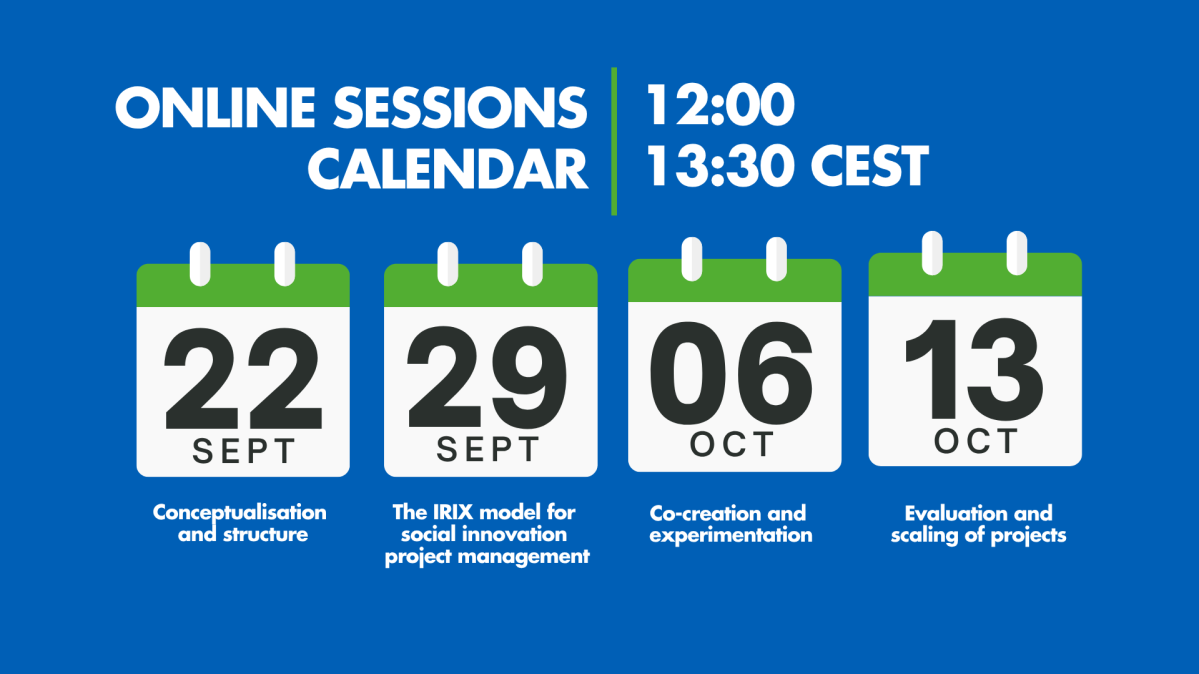
Save the dates for the online training sessions
Discover the content of the training programme
Social innovation: A 50-piece puzzle — Conceptualisation and structure (22 sep)
What is social innovation—or, more precisely, what can social innovation mean from different perspectives? In this work, we focus on one particular perspective. To bring greater clarity and structure to this complex concept, we break down the social innovation of a project into five vectors, each comprising ten variables: a 50-piece puzzle that helps us see the bigger picture. By breaking down a complex and often diffuse reality into more tangible and manageable elements, we can make it easier to understand, assess, and ultimately shape.
How do I organise the route and start the journey? — The IRIX model for social innovation project management (29 sep)
Having established the puzzle of what social innovation is in the previous session, we now have a clear understanding of the “what.” In this second session, and throughout the sessions that follow, we turn our attention to the “how” by introducing our own framework for systematising the process: the IRIX methodology for managing social innovation projects. This methodology helps us understand the logic, sequence, and overall structure of the management process. We begin by exploring the first two phases—or tasks—which focus on the design of the project: project identification and challenge exploration. For each phase, we look at what it involves, who should be involved, and the key recommendations that emerge from practical experience.
From pilots to collaborative solutions — Co-creation and experimentation (06 oct)
In this third session, we continue our journey through IRIX, exploring two core phases: co-creation and solution experimentation. We will look at each phase in detail from a human-centred innovation perspective, introducing and putting into practice tools for collaborative design and iterative prototyping. For each phase, we will explore what it involves, who should be part of the team, and key recommendations drawn from practical experience. We will also connect these phases back to the pieces of the puzzle, showing how they help a project strengthen its feasibility, social value, and transformative potential.
When I grow up, I want to BE — Evaluation and scaling of projects (13 oct)
In this fourth session, we explore what ultimately gives social innovation its meaning: understanding whether it generates positive outcomes and, when it does, how to scale and extend its impact. We innovate to scale—to enable successful solutions to grow, reach more people and contexts, and create lasting change. We will examine evaluation systems and take a deeper look at the scaling journey. Along the way, we will provide methodological guidance grounded in years of practical experience, with a particular focus on the lessons learned from scaling social innovations across organisations and European countries. Since 2025, the Network has been systematically supporting this process, which will continue through 2029.
Do you want to be part of the training?
Before registering, please take a moment to review the key requirements and practical information below to make sure the course is the right fit for you and your organisation.
- Be a professional representing an organisation that is a member of the European Network of Innovation for Inclusion (ENII). Only one participant per member organisation can take part in the course.
- Commit to attending all live sessions and actively participating in the course. Only participants who successfully complete the course will receive a micro-credential.
- The course will be delivered entirely in English. Participants must be able to communicate fluently in English and actively engage in the sessions.
BECOME A MEMBER OF THE EUROPEAN NETWORK
Don’t miss the opportunity to join the course, expand your knowledge, and connect with other professionals interested in this field.
